Few forms of entertainment have travelled quite as far — culturally and geographically — as karaoke. What began as a Japanese pastime in the early 1970s has since become a global phenomenon, filling pubs, private booths and events from Tokyo to Telford.
This article covers the full history of karaoke: what karaoke actually is, where the word comes from, who invented the first karaoke machine, when it arrived in the UK, and how the format evolved from a novelty into a serious entertainment industry. Along the way, we’ll clear up some of the myths that tend to surround its invention and stick to what the evidence actually tells us.
What is karaoke?
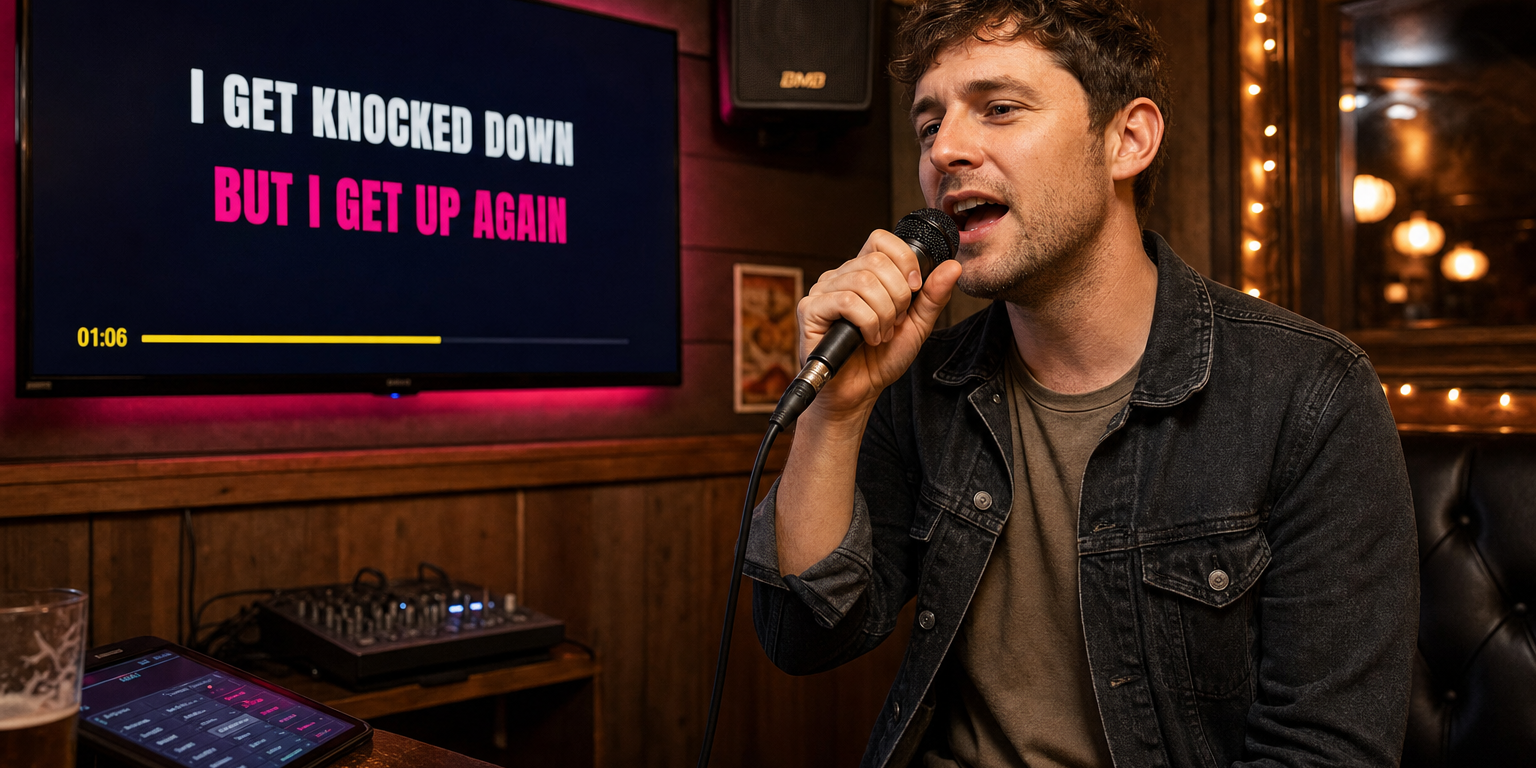
Karaoke is an interactive form of entertainment where a person sings along to a prerecorded instrumental track while lyrics are displayed on a screen, typically highlighted in time with the music.
The core setup is straightforward: a microphone, a backing track with the vocals removed, and a screen showing the words so the singer can follow along. Lyrics are usually colour-coded or highlighted beat by beat, making it accessible even for those who don’t know a song by heart. No musical ability required — that’s rather the point.
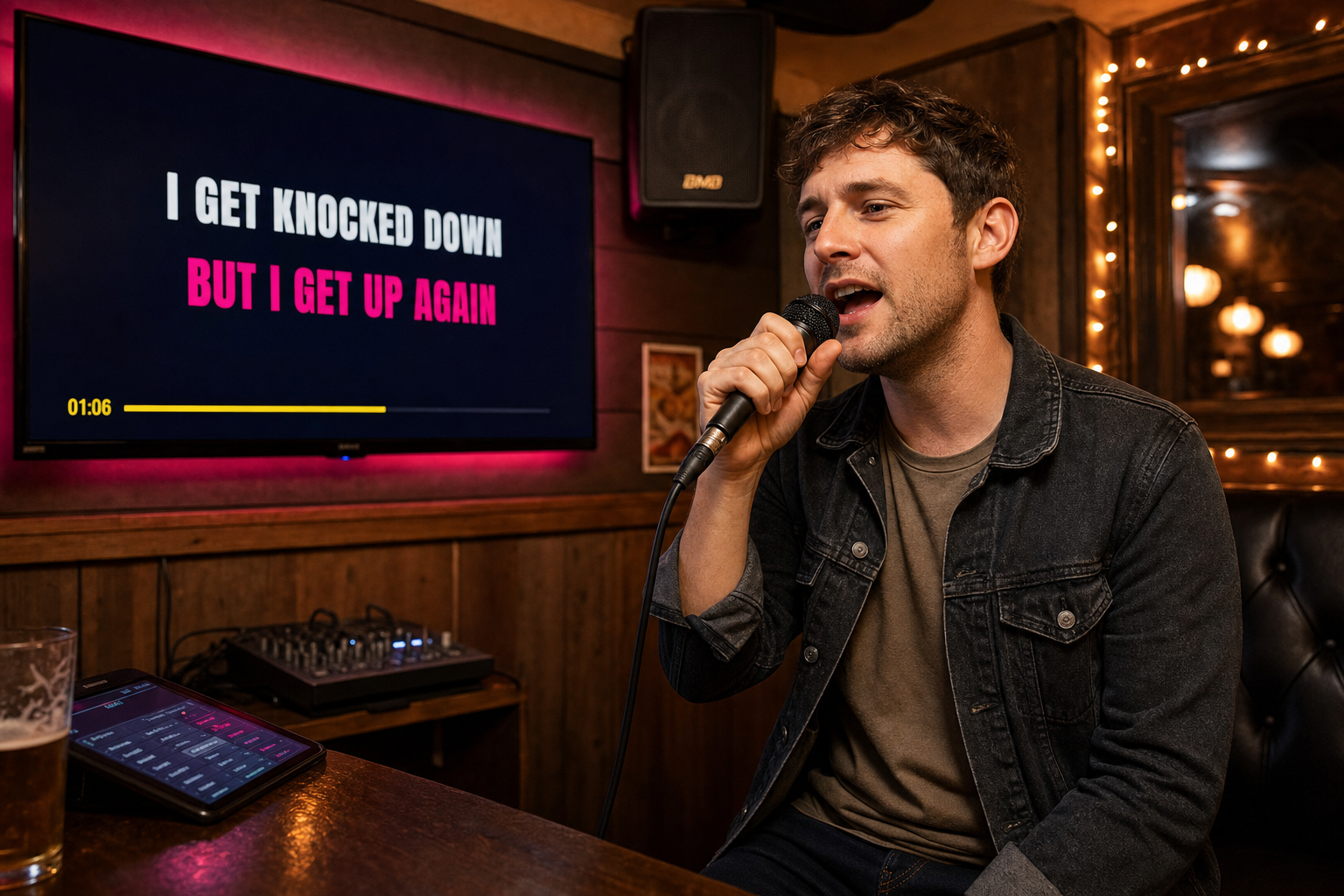
Karaoke turns up in a wide range of settings: pub nights, private hire rooms (known as karaoke boxes), home parties, weddings, corporate events and beyond. The format suits almost any occasion where people want to let loose and have fun together.
Over the decades, the technology has shifted considerably — from tape cartridges and laser discs through to the digital and app-based systems used today — but the basic experience has remained the same since karaoke first appeared in Japan.
Is karaoke Japanese?
Yes — modern karaoke is Japanese in origin, developing in bars and entertainment venues during the late 1960s and early 1970s.
At that time, live music was a staple of Japanese nightlife, with singers performing alongside house bands in bars and clubs. As the concept evolved, prerecorded backing tracks began replacing live musicians, allowing ordinary customers — not just professional singers — to take the microphone. This shift proved enormously popular.
From these relatively informal beginnings, karaoke grew quickly into a mainstream form of entertainment across Japan. Dedicated machines became commercially available, and purpose-built karaoke boxes — private rooms hired by the hour — became a fixture of Japanese social life by the 1980s. As the concept spread to other parts of Asia and then to the West, it adapted to local tastes, but its roots remained firmly in the bars and back rooms of Japan.
What does karaoke mean in Japanese?
‘Karaoke’ translates as ’empty orchestra’ — a compound of two Japanese words: kara (空), meaning empty, and oke, a shortened form of ōkesutora, the Japanese pronunciation of ‘orchestra’.
The name is remarkably apt. When you sing karaoke, the orchestra is there in recorded form, but the lead voice is absent — leaving an empty space for you to fill. The music plays; the singer is whoever picks up the microphone.
It’s a simple concept captured neatly in two syllables, which may partly explain why the word travelled into English and other languages without being translated at all. Most people around the world now use the Japanese term directly, even if they’ve never thought about what it actually means.
Who invented karaoke? The history of karaoke’s origins
The honest answer is that karaoke doesn’t have a single inventor. Different people developed the concept independently, and it’s worth distinguishing between the earliest recognised machine and the person most credited with popularising it commercially.
Shigeichi Negishi and the Sparko Box (1967)
The earliest recognised karaoke machine is generally attributed to Shigeichi Negishi, who developed a device called the Sparko Box in 1967. This coin-operated machine allowed users to sing along to prerecorded music, making it the first known purpose-built karaoke system.
Daisuke Inoue and the 8 Juke (1971)
Daisuke Inoue is the name most often associated with karaoke’s invention, and his contribution was enormous — though he arrived a few years after Negishi. Working in Kobe, Inoue independently developed the 8 Juke machine in 1971, a coin-operated device he placed in bars and clubs across the region. His approach to distributing the machines and building a network of venues was key to turning karaoke from a local curiosity into a genuine commercial phenomenon. Inoue famously never patented his invention, which allowed the concept to spread freely — and meant he saw little financial reward as it grew into a global industry.
Roberto del Rosario and international patent activity
Roberto del Rosario, a Filipino inventor, later developed the Sing-Along System and pursued patents related to karaoke technology. His activity forms part of the international commercial and legal history of karaoke, but it came after the Japanese developments and does not represent the original invention of the format.
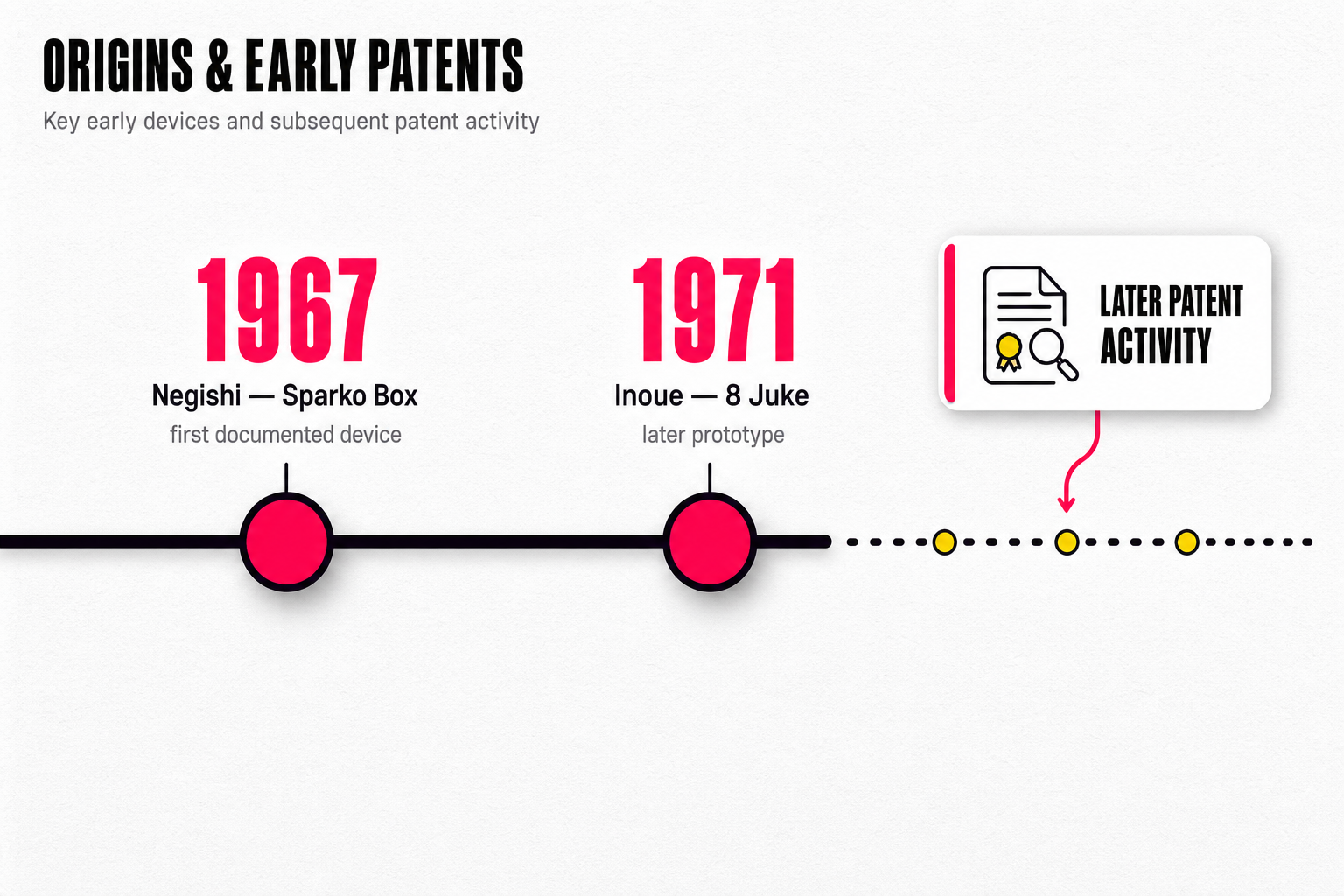
A brief timeline puts it in perspective:
- 1967 — Shigeichi Negishi develops the Sparko Box, the earliest recognised karaoke machine
- 1971 — Daisuke Inoue independently creates the 8 Juke in Kobe, helping launch commercial karaoke
- Later — Roberto del Rosario pursues Sing-Along System patents internationally
When was karaoke invented?
The earliest recognised karaoke machine dates to 1967, when Shigeichi Negishi developed the Sparko Box. However, 1971 is the date most commonly cited — the year Daisuke Inoue independently created the 8 Juke and began placing it in bars and entertainment venues across Japan.
The reason both dates appear so often comes down to a distinction between invention and popularisation. The Sparko Box represents the earliest known device of its kind, but it was Inoue’s 8 Juke and his commercial approach to distributing it that transformed karaoke from a novel machine into a format that spread across Japan and, eventually, the world.
So if someone asks when karaoke was invented, 1967 is the most historically accurate answer for the first machine — but 1971 marks the moment the modern commercial format effectively began. Both dates are part of the history of karaoke, and neither tells the full story on its own.
When did karaoke start in the UK?
There is no single, universally documented date for when karaoke arrived in Britain. The format spread gradually rather than launching at a specific moment, which makes it difficult to pin down a precise national start.
Industry accounts point to the early 1980s as the period when karaoke equipment first appeared in the UK. One company, Karaoke UK, has described itself as the first importer of karaoke machines into Britain, citing 1981 as the year it began. That’s worth noting as an industry claim, though it represents one company’s account rather than an independently verified national milestone — and “first importer” is a difficult thing to establish conclusively given how informal early imports often were.
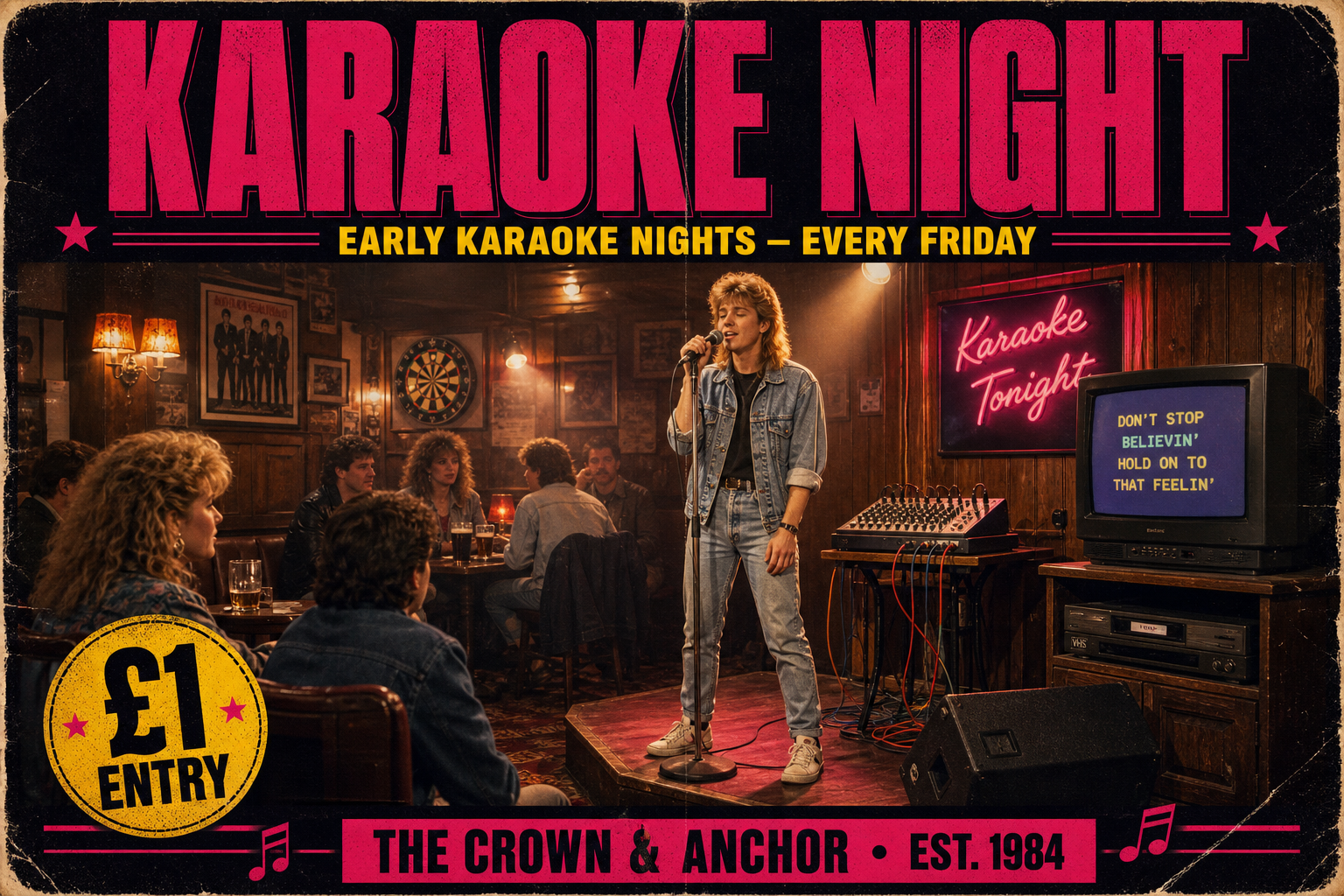
Whether or not 1981 marks the true beginning, the broader pattern of adoption is fairly clear. Equipment was finding its way into British venues through the early 1980s, initially as a novelty — often in Japanese restaurants, hotel bars and specialist clubs rather than ordinary pubs. Through the mid-to-late 1980s, karaoke nights became an increasingly familiar fixture in bars and working men’s clubs across the country, particularly in northern England.
By the late 1980s and into the 1990s, karaoke had crossed from curiosity into mainstream British entertainment. The format became synonymous with pub culture — a Friday night staple that needed no explanation. Television exposure helped cement its place in popular culture, and dedicated karaoke hosts and equipment hire companies began to emerge as a genuine industry.
The karaoke history in the UK, then, is less a single arrival and more a steady infiltration — one that quietly took hold until suddenly it was everywhere.
How karaoke technology has evolved
Karaoke technology has changed enormously since those first coin-operated machines in Japan. The broad progression runs from tape-based systems and printed songbooks, through LaserDiscs and CD+G, to digital hard drives and now streaming platforms and mobile apps.
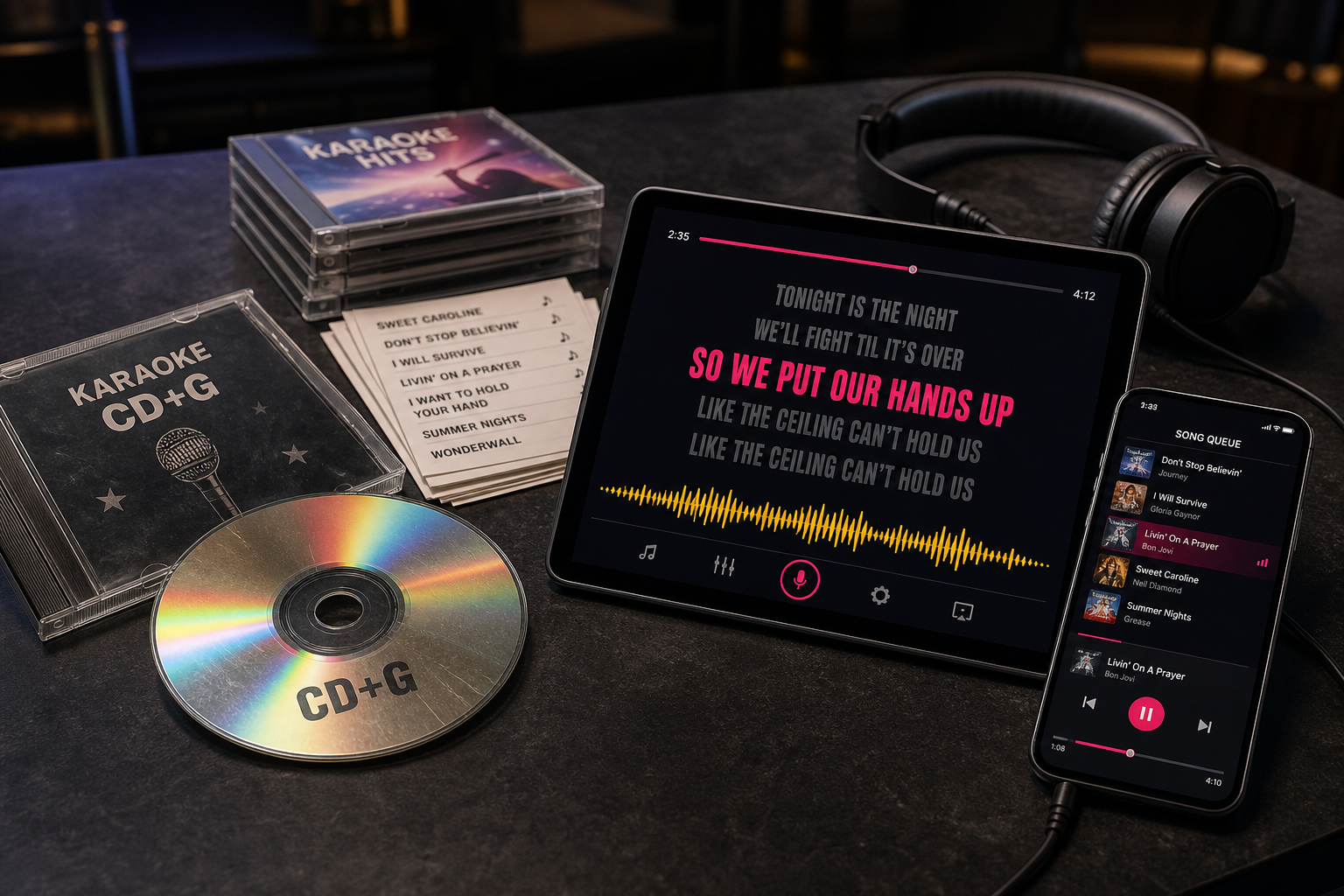
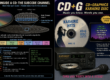
CD+G was the industry standard for years — hosts would carry crates of discs to every gig. That gradually gave way to digital song files stored on hard drives, which made catalogues far more manageable and portable. The industry has since moved largely towards streaming, which offers vast online libraries and makes updating songs as simple as a software refresh.
Each transition has made karaoke more accessible: larger catalogues, less physical kit, and lower barriers for both hosts and venues. Modern karaoke machine hire setups can offer thousands of songs through a single device — something that would have been unthinkable in the CD+G era. Mobile apps have also brought karaoke into the home, extending the format well beyond its pub and club roots.
Karaoke history: a pastime that became a global industry
Karaoke has a richer history than most people realise. Born in Japan through the independent work of Negishi and Inoue, carried to the UK in the early 1980s, and transformed over the decades from coin-operated machines to sleek streaming systems — what started as a local entertainment format is now genuinely global, and it shows no signs of slowing down.
If all this has got you in the mood to grab a microphone, we can help. Browse our karaoke machine hire options to find the right setup for your event, or contact us and we’ll point you in the right direction.